Read the original article on UCLA Magazine.
When UCLA first opened its doors as the Southern Branch of the University of California in September 1919, the inaugural student council established an honor code. The code, it was felt, would serve as a template — something akin to a North Star — for students’ scholarly and social conduct. It was an effort, and a successful one, to bolster the foundation of a fledgling institution that would go on to become, in short order, a world-class university.
Nearly a century later, at the start of the new millennium, UCLA formalized its inaugural set of “True Bruin Values” — respect, accountability, integrity, service and excellence — drawn from principles from the UC Office of the President. Now, 107 years after UCLA’s founding, these values continue to evolve.
In his first year in office, UCLA’s seventh chancellor, Julio Frenk, has emphasized the university’s identity as an institution of higher learning focused on connectivity, ingenuity and serving as an example to other universities in Los Angeles and beyond. Among the many bold initiatives Frenk outlined in his “State of the Campus” address in May was a campuswide effort to shape a set of renewed, streamlined blue-and-gold values for UCLA’s second century, succinctly summed up in three words: integrity, excellence and belonging.
Going forward, UCLA will introduce new ways for all Bruins to engage with these refreshed values — and with one another — to bring them to life across campus and beyond.
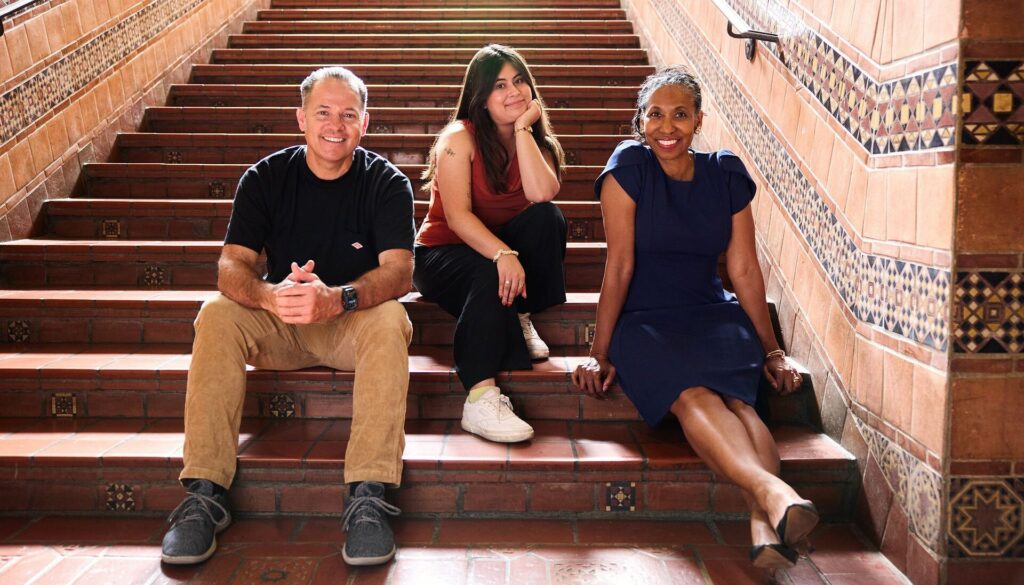
But these words are hardly strange to any of us who are part of the UCLA ecosystem. We see them reflected in students, in faculty, in staff, in alumni, in our donor community, in the people who proudly wear their Bruin pride on their sleeves. Need proof? (You don’t, but we had to ask.) Meet three members of our UCLA community who embody our revitalized True Bruin Values — and get their best advice for how we can all come together to do the same.
BELONGING
The Homebuilder: Daniela Cortez Bravo
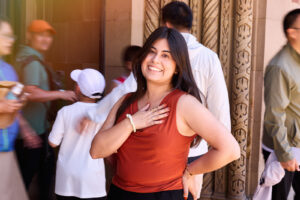
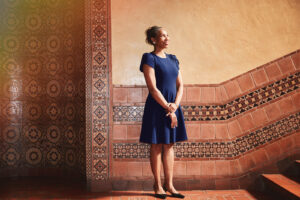
When her family immigrated to San Jose, Calif., from Mexico in the early aughts, Daniela Cortez Bravo ’24, M.A. ’25 never imagined that nearly two decades later, fresh out of high school, she — the youngest daughter — would be the first in her family to leave home.
It was a bittersweet decision, one that unfolded during a moment of profound global disruption. Cortez Bravo began her undergraduate journey at UCLA in the summer of 2020, when the COVID-19 pandemic had pushed much of campus life online. Like many first-generation students navigating higher education for the first time — and in her case, initially doing so 300 miles away from campus — she had to find belonging in entirely new ways. But how, she asked, when everyone was literally isolating?
Her answer: forming a vision and keeping it front and center. “For me, belonging meant finding people that could make such a large campus feel smaller,” she says. “It was about feeling supported enough to imagine not just myself, but my community, thriving here.”
One of her earliest moments of connection came during a virtual Latinx Admit Weekend, where triple Bruin José M. Aguilar-Hernández’s ’03, M.A. ’07, Ph.D. ’13 remarks created something she had rarely experienced: a space made possible by — and for — students like her.
Wrapped snugly in a comfy blanket and listening from her bedroom, Cortez Bravo — who is now pursuing a Ph.D. in education at UCLA, the very same doctoral program Aguilar-Hernández graduated from — felt the walls around her expand. Aguilar-Hernández invited students to look down at the bricks that have built UCLA if they ever feel out of place. They’re a reminder, he said, that while institutions like UCLA were not always designed with communities of color in mind, they were nonetheless shaped by their labor, their histories, their presence.
The image was powerful, and it stayed with Cortez Bravo. It reframed how she understood her place at UCLA and her ability to use that understanding to welcome and empower others.
“Belonging isn’t just about fitting into a community,” she says. “It’s about building one, no matter where your starting point is. Belonging shouldn’t be conditional. It should be an assurance — something every student can expect when they arrive.”
Fueled by a new sense of responsibility, Cortez Bravo became deeply involved in UCLA’s Hispanic-Serving Institution initiative, where she served as a student liaison beginning in 2023. In that role, she helped create spaces for students to collaboratively shape the future of the Latinx Success Center: co-facilitating student town halls, building student collaboratives and developing the bylaws for the center’s inaugural Student Advisory Board. The board, she says, was designed to institutionalize student voices in the center’s shared governance, ensuring that future generations of students would have a permanent role in shaping the LSC.
“I knew I wouldn’t complete this work myself,” she says. “I wanted to make sure there was something future students could build on.”
Drawing on her experiences as an academic affairs commissioner with UCLA’s Undergraduate Students Association Council, as well as on models from other institutions, Cortez Bravo approached the work with a focus on what scholars call “servingness” — a nationally adopted framework that encourages institutions to move beyond simply enrolling students to serving them: centering culturally sustaining practices; promoting student agency; and ensuring that students have an active role in shaping campus culture, policies and resources that support their success and sense of belonging.
Cortez Bravo has succeeded in doing just that.
For her, fostering belonging is inseparable from building relationships across differences, a reflection of the chancellor’s own Dialogue Across Difference campaign. She sees collaboration, the sense of belonging that it can create, as fundamentally human.
“When we take time to understand each other’s stories,” she says, “we’re better able to navigate differences with care and curiosity. That’s what sustains meaningful work.”
EXCELLENCE
The Unrelenting Advocate: Angela Deaver Campbell
At an early June senior awards night at Huntington Park Senior High School, Angela Deaver Campbell — assistant dean in the UCLA College’s Division of Undergraduate Education and executive director of the Center for Scholarships and Scholar Enrichment — took the stage to present a life-changing opportunity to a student.
That evening, she awarded one graduating senior the Delson Scholarship, a $10,000 annual award that helps make a UCLA education more attainable. It’s a moment she has witnessed — and helped create — many times during her decades of service at the university, which began in 1989. At University High School in West Los Angeles, for example, she presents the Thelma L. Culverson Scholarship — a full-ride award funded by its namesake UCLA alumna, who graduated in 1960 with a degree in economics before becoming a successful business executive — that covers tuition along with room and board for four years for one UHS graduate who is UCLA-bound. That’s the path taken by Culverson herself over a half-century ago.
“When we go to present that scholarship, they always have us go first,” Deaver Campbell says. “Because when you tell a room full of students that one of their own is going to UCLA and won’t have to worry about how to pay for it, there’s always this collective gasp. It’s freeing.”
That sense of freedom — from financial uncertainty, from the weight of debt — is central to how Deaver Campbell understands the concept of excellence.
When the Center for Scholarships and Scholar Enrichment first opened in 1996 as the Scholarship Resource Center, it reflected a then-novel idea: that students needed one centralized place, a nexus, where they could find all of the potential scholarships available to them. But over time, Deaver Campbell and her colleagues realized the work extends far beyond helping students secure funding. It can also include helping students find formal wear for high-stakes in-person interviews or connecting them with a cadre of doctoral students who offer support by helping with crafting scholarship essays and by conducting mock interviews. Whether they’re a first-year, transfer, reentry or international student, the CSSE does it all for them.
The center’s name was eventually updated to better reflect its broader role as not just a resource, but also as a space devoted to ongoing scholar support and enrichment.
“My work begins once students are awarded,” she says. “That’s when the real support starts.”
At CSSE, that support is intentional, sustained and deeply personal. Students receiving donor-funded scholarships meet regularly with advisors throughout the academic year to talk through both academic and personal challenges. CSSE’s goal is not only to help them maintain their awards, but to also ensure that they thrive.
“If they need a referral, if they want help preparing a presentation, if they’re working on a personal statement — whatever they need — we find a way to help,” she says. “That’s what stewarding is about. It’s high touch. It’s holistic. It’s a lot of work. But the outcomes are always better.”
That idea of stewardship — of staying with students long after the moment of recognition — also extends to students who may find themselves having to unexpectedly pivot.
Deaver Campbell recalls one international student from Ukraine who arrived at UCLA with a full financial plan in place. When war broke out in her home country, that support vanished. “We had to find a way to help her stay,” Deaver Campbell says. “That’s what this center is here for — to help students help themselves when things change.”
In another case, a reentry student who had to balance parenting with school returned to thank her just before graduation, sharing how those regular check-ins had made all the difference. For Deaver Campbell, these stories aren’t exceptions. They’re the work.
Excellence, in her view, is not just about achievement. It’s about persistence, access and the ability to remain enrolled, even when the path is not linear. “It’s not easy to graduate with a degree from UCLA; it’s not always a straight line,” she says. “There are zigzags. But we have the best and the brightest students at UCLA, and they should have a place that helps them stay the course.”
INTEGRITY
The Ambassador of Understanding: Benjamin Lewis
When Benjamin Lewis received the call in 2012 that he would be teaching at UCLA, he was floored. “I remember being shocked,” he recalls. “I couldn’t believe I would be working here.”
He saw the university as an exemplar of education. And he felt welcomed from the outset, as both he and his courses — such as American Sign Language 1 through 6 and others in Deaf history and culture — were warmly embraced. In and out of the classroom, Lewis has held himself to an honor code, guided by an unshakable moral compass and sense of integrity that have defined his teaching and life philosophy: “Learn the basics. Maintain eye contact. Be patient. And understand that recognizing the humanity of deaf individuals is a shared responsibility,” he reflects.
More than a decade later, his ASL courses continue to fill up seemingly within seconds. Whether students seek to satisfy graduation requirements or are curious to learn more about the third most commonly used language in the United States behind English and Spanish, countless Bruins have taken and been changed and empowered by his courses. But for Lewis, who is deaf, enrollment numbers are beside the point.
What matters is what happens once students walk through the door.
“I want every student to feel welcome,” he says, “while also recognizing that they are entering a community with its own rich history, values and experiences.”
As UCLA’s very first ASL instructor, Lewis has helped shape not just a curriculum but an entire community. Central to his approach is a simple but powerful idea: Learning ASL is not just about learning a language; it’s about using its lessons, its viewpoints, to reorient how one moves through the world.
In his classroom, students are asked to do more than memorize signs. They are encouraged to become thoughtful communicators, to engage with deaf culture on its own terms and to understand that deafness is not something needing fixing, but a lived identity to be understood and respected.
“Ultimately,” he says, “I hope my students carry forward the understanding that the goal is not always to fix differences, but to recognize, respect and value them.”
That philosophy is perhaps best captured in one of his favorite signs: community.
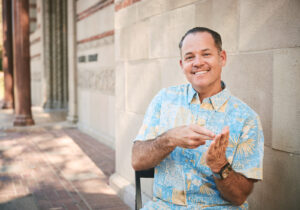
Press play to watch Lewis sign the word community:
“The movement reflects people coming together and supporting one another,” Lewis explains. “It represents connection, shared understanding and collective strength in a way that feels deeply visual and powerful.”
For Lewis, that sense of shared understanding is the foundation of belonging — not just in his classroom, but across campus. Many of his students arrive with little or no prior exposure to deaf people and culture. Over the course of the quarter, they begin to see ASL differently: as something that extends beyond communication and allows for a means of connection shaped by context, culture and care. The impact of that shift often becomes visible long after the class ends.
“Watching former students soar in their own careers and continue their connection to the deaf community is incredibly gratifying,” he says.
Some have gone on to study at Gallaudet University in Washington, D.C., Lewis’ alma mater and a leader in ASL instruction; others have become advocates and attorneys working with the National Association of the Deaf or professionals collaborating with organizations like Deaf West Theatre. Across fields, they carry forward what they learned — that ASL is not just a language, but a whole new perspective, a worldview.
“As a teacher, there is no greater reward than knowing that the impact of your classroom extends beyond the quarter,” Lewis says. “What stands out most is not simply the growth in enrollment, but the growing number of students who become lifelong allies, advocates and contributors to the deaf community.”
After nearly 15 years at UCLA, Lewis is especially proud that with his own two hands — one sign at a time — he has taught students lessons that ripple throughout classrooms, professions and communities far beyond Westwood.
“I remain grateful,” he says, “for the opportunity to help students discover not only a new language, but a new way of seeing the world.”